

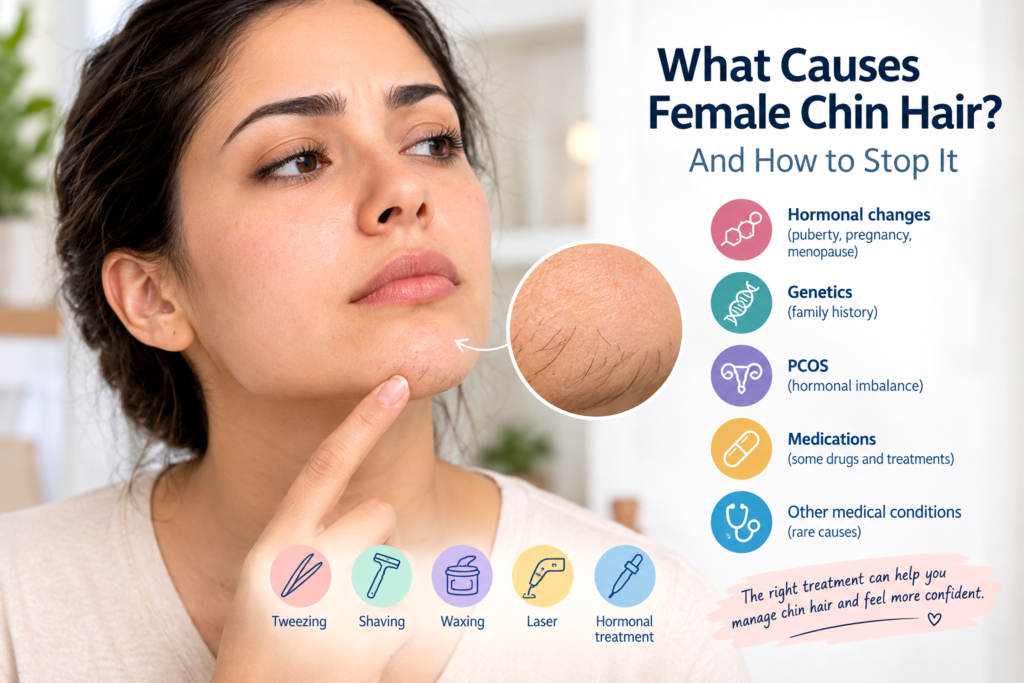
A few dark hairs on your chin can be frustrating, especially when they seem to appear overnight. But chin hair is not always a sign of a health problem. For many women, it is simply part of their natural hair-growth pattern.
Genetics, age, hormonal changes, and the way individual hair follicles respond to hormones can all influence facial hair growth.
The good news is that several practical methods can help you manage unwanted chin hair and keep your skin looking smooth.
Why Does Chin Hair Grow in Women?
Most women have fine, barely visible hair on their faces. This is known as vellus hair. In some cases, certain hairs become thicker, darker, and longer. These are called terminal hairs.
Several factors can contribute to this change.
1. Hormonal Changes
Hormonal changes throughout life can affect facial hair growth. Puberty, pregnancy, and menopause may influence the way hair grows.
As women age, changes in hormone levels can make some facial hairs more noticeable. This does not necessarily mean that something is wrong.
2. Genetics
Your family history can influence how much facial hair you have.
If your mother or other female relatives have noticeable chin hair, you may have inherited a similar hair-growth pattern.
Genetics can affect:
- Hair thickness.
- Hair color.
- The number of visible facial hairs.
- The areas where coarse hair develops.
- The age at which facial hair becomes noticeable.
Having facial hair because of genetics is a normal variation and does not automatically indicate a medical condition.
3. Natural Changes With Age
Some women begin noticing chin hair in their forties or fifties, even if they had very little facial hair when they were younger.
This can happen because hair follicles change over time and may respond differently to hormonal fluctuations.
A few isolated hairs are generally not a reason for concern.
4. Individual Hair-Follicle Sensitivity
Hair follicles do not all respond to hormones in exactly the same way.
Some follicles may be more sensitive to normal hormonal activity. As a result, one woman may develop several dark chin hairs while another woman with a similar hormonal profile may not.
This difference is one reason facial-hair patterns vary from person to person.
When Should You Pay Attention to New Chin Hair?

A few occasional chin hairs are usually harmless. However, a noticeable change in facial-hair growth may be worth discussing with a healthcare professional.
Consider seeking medical advice if:
- Your facial hair increases significantly over a short period.
- You notice a substantial change in your usual hair-growth pattern.
- New facial hair appears alongside other unexplained changes in your health.
- You are concerned about persistent or increasing unwanted hair.
A healthcare professional can help determine whether the growth is a normal variation or whether further assessment would be useful.
You do not need to assume that every chin hair indicates a hormonal disorder.
How to Remove Female Chin Hair
There are several ways to manage unwanted chin hair. The best option depends on the number of hairs, your skin sensitivity, and how long you want the results to last.
1. Tweezing
Tweezing is a practical option when you have only a few noticeable chin hairs.
A pair of clean tweezers can remove individual hairs from the root, leaving the area smooth for longer than shaving usually does.
How to tweeze safely
- Wash your hands and cleanse the skin.
- Use clean tweezers.
- Hold the hair close to the skin.
- Pull gently in the direction of hair growth.
- Avoid repeatedly digging into the skin.
- Apply a gentle moisturizer if the area feels irritated.
Tweezing may cause temporary redness or irritation. If you frequently develop ingrown hairs, consider another method.
Does tweezing make hair grow back thicker?
No. Tweezing does not generally make hair follicles produce thicker hair. Regrowth may feel noticeable, but plucking does not change the follicle in that way.
2. Shaving
Shaving is a quick and convenient way to remove chin hair.
It cuts the hair at the surface of the skin without removing the follicle. Because of this, the results are temporary.
Tips for shaving chin hair
- Use a clean facial razor.
- Wet the skin before shaving.
- Apply a gentle shaving product.
- Move the razor lightly across the skin.
- Avoid repeatedly shaving the same area.
- Moisturize afterward.
Shaving does not make hair grow back darker or thicker. Newly cut hair may simply feel rougher because its tip is blunt.
A facial trimmer can also be a convenient alternative.
3. Threading
Threading uses twisted cotton thread to remove individual hairs.
It can be useful for removing several unwanted hairs around the chin or upper lip without applying chemical products to the skin.
The results are temporary, and some people may experience redness or irritation afterward.
Choose a clean, reputable salon or use appropriate hygiene practices if threading at home.
4. Waxing
Waxing removes hair from the root and can leave the skin smooth for several weeks.
It may be suitable for some people, but facial skin can be sensitive. Waxing may cause redness, irritation, or ingrown hairs.
Avoid waxing over irritated or damaged skin. If you use strong skincare products that make your skin sensitive, seek professional advice before waxing.
Waxing does not permanently stop hair growth.
5. Facial Depilatory Creams
Depilatory creams dissolve the hair near the skin’s surface.
They can be convenient, but not every product is suitable for facial use.
Before applying one:
- Choose a product specifically designed for the face.
- Follow the instructions carefully.
- Perform a patch test according to the product directions.
- Never leave the cream on longer than recommended.
- Stop using it if you experience burning or significant irritation.
These creams remove existing hair but do not prevent future growth.
6. Laser Hair Removal
Laser hair removal is an option for women who want longer-term reduction in unwanted facial hair.
The treatment uses concentrated light to heat and damage targeted hair follicles. Several sessions are usually needed because hair follicles grow in different stages.
Laser treatment may work particularly well on darker hair, while very light hair may respond less effectively.
Results vary from person to person. Laser hair removal does not guarantee that every hair will disappear permanently.
Choose a qualified practitioner who has experience treating your skin tone and hair type.
7. Electrolysis
Electrolysis is another professional hair-removal option.
It uses a fine probe and electrical energy to treat individual hair follicles. Because it targets individual follicles, it may be useful for people with a small number of persistent hairs.
Several sessions may be required. Temporary redness or irritation can occur.
Choose a qualified professional who follows appropriate hygiene and safety procedures.
Common Myths About Female Chin Hair
Myth 1: Shaving makes chin hair thicker
Shaving does not change the thickness of the hair follicle. The hair may feel rougher when it grows back because it has been cut.
Myth 2: Every woman with chin hair has a hormonal problem
A few chin hairs can be a normal genetic or age-related variation. Facial hair alone does not establish a medical diagnosis.
Myth 3: Plucking makes hair grow faster
Tweezing does not generally make hair grow faster or cause the follicle to produce thicker hair.
Myth 4: Laser hair removal works equally well for everyone
Treatment results depend on hair color, skin tone, hair characteristics, and the equipment and expertise used.
Myth 5: Home remedies can permanently remove chin hair
There is no reliable home remedy proven to permanently destroy unwanted chin-hair follicles.
How to Care for Your Skin After Hair Removal
Good aftercare can help reduce irritation.
- Use a gentle moisturizer.
- Avoid harsh exfoliation immediately after hair removal.
- Do not repeatedly touch or scratch the treated area.
- Protect your skin from excessive sun exposure.
- Stop using a method if it causes persistent irritation.
- Follow the aftercare instructions provided by a qualified professional.
If you experience severe irritation, swelling, or signs of infection, seek medical advice.
Female chin hair is common and can develop for several reasons, including genetics, age, and natural hormonal changes. Having a few stray hairs does not necessarily mean that you have a health problem.
Simple methods such as tweezing, shaving, and threading can help manage unwanted hair at home. For longer-term results, professional options such as laser hair removal and electrolysis may be worth considering.
The best approach is to choose a hair-removal method that suits your skin and hair type, while paying attention to any unusual changes in hair growth.
Medical disclaimer: This article is intended for general informational purposes only. It does not replace professional medical advice, diagnosis, or treatment.